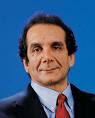
Showing posts with label Krauthammer. Show all posts

Friday, June 22, 2007

Krauthammer On Hamas & Fatah, Challenges & Bench Marks

Charles Krauthammer sees the challenges and opportunities in the clarification of Hamas Fatah scenario, as well as noting how Israel, with the hands on the controls of Gaza's water, gas and electricity has Hamas by its radical Islamic short hairs:

Gaza is now run not by a conventional political party but by a movement that is revolutionary, Islamist and terrorist. Worse, Hamas is a client of Iran. Gaza now constitutes the farthest reach of the archipelago of Iranian proxies: Hamas in Palestine, Hezbollah in Lebanon, the Mahdi Army (among others) in Iraq and the Alawite regime of Syria.

This Islamist mini-replica of the Comintern is at war not just with Israel but with the moderate Arab states, who finally woke up to this threat last summer when they denounced Hezbollah for provoking the Lebanon war with Israel. The fall of Gaza is particularly terrifying to Egypt because Hamas is so closely affiliated with the Muslim Brotherhood, the chief Islamist threat to the secular-nationalist regime that has ruled Egypt since the revolution of 1952. Which is why Egypt has just invited Israeli, Jordanian and moderate Palestinian leaders to a summit next week -- pointedly excluding and isolating Hamas.

The splitting of Palestine into two entities is nonetheless clarifying.

. . . The policy implications are obvious. There is nothing to do with the self-proclaimed radical Islamist entity that is Gaza but to isolate it. No recognition, no aid (except humanitarian necessities through the United Nations), no diplomatic commerce.

Israel now has the opportunity to establish deterrence against unremitting rocket attacks from Gaza into Israeli villages. Israel failed to do that after it evacuated Gaza in 2005, permitting the development of an unprecedented parasitism by willingly supplying food, water, electricity and gasoline to a territory that was actively waging hostilities against it.

With Hamas now clearly in charge, Israel should declare that it will tolerate no more rocket fire -- that the next Qassam will be answered with a cutoff of gasoline shipments. This should bring road traffic in Gaza to a halt within days and make it increasingly difficult to ferry around missiles and launchers.

If that fails to concentrate the mind, the next step should be to cut off electricity. When the world wails, Israel should ask, what other country on Earth is expected to supply the very means for a declared enemy to attack it?

Regarding the West Bank, policy should be equally clear. Palestinian Authority President Mahmoud Abbas represents moderation and should be helped as he tries to demonstrate both authority and success in running his part of Palestine.

But let's remember who Abbas is. He appears well intentioned, but he is afflicted with near-disastrous weaknesses. He controls little. His troops in Gaza simply collapsed against the greatly outnumbered forces of Hamas. His authority in the West Bank is far from universal. He does not even control the various factions within Fatah.

But the greater liability is his character. He is weak and indecisive. . .

Moreover, his Fatah party is ideologically spent and widely discredited. Historian Michael Oren points out that the Palestinian Authority has received more per capita aid than did Europe under the Marshall Plan. This astonishing largess has disappeared into lavish villas for party bosses and guns for the multiple militias Arafat established.

The West is rushing to bolster Abbas. Israel will release hundreds of millions in tax revenue. The United States and the European Union will be pouring in aid. All praise Abbas as a cross between Anwar Sadat and Simón Bolívar. Fine. We have no choice but to support him. But before we give him the moon, we should insist upon reasonable benchmarks of both moderation and good governance -- exactly what we failed to do during the Oslo process. Abbas needs to demonstrate his ability to run a clean administration and to engage Israel in day-to-day negotiations to alleviate the conditions of life on the ground.

Abbas is not Hamas. But despite the geographical advantages, he does not represent the second coming, either. We can prop him up only so much. In the end, the only one who can make a success of the West Bank is Abbas himself. This is his chance. His last chance.
Read the entire story here. Finally, some benchmarks we can get behind. This sounds perfectly appropriate and far more sound then just opening the spigots. We may have to force Fatah to succeed as a nation - rather then subsidize opulence for its war lords. Perhaps, given their recent fate in Gaza, we may find Abbas and his gang a bit more willing this time.

Read More...

Monday, May 14, 2007

Krauthammer - Of Dogs & Men

I ran across this eloquent piece the other day by Charles Krauthammer, wherein he mourns the loss of his family's labrador retriever and speculates on the historical development of human-house pet relationships.

I couldn't resist posting this one. If you haven't noticed the pic on the side of this blog, I have three labrador retrievers. I am a true fanatic when it comes to labs. Life with them is 5% speechless anger (things chewed), 10% resignation (same things chewed more), and 85% pure enjoyment (all else). Labs almost all share common traits that Krauthammer captures perfectly in this article. They are boisterous, incredibly friendly, and have only one speed - full bore. Until they hit about age three, they are unguided missles with the mind of a friendly puppy stuffed into a 60 to 90 lbs frame - usually. And no matter how hard or bad your day, you can always, always count on getting the exact same greeting from the hounds the moment you walk in the door - pure tail wagging, face licking, lab jumping anarchy. I know that I could train that out of them, but I never have wanted to do so.

And they each have unique personality. Daisey has the speed and grace of a gazelle combined with the intelligence of a canine evil genuis. And she, more so then the others, is convinced she is a human. It is not uncommon to find her sitting at the table awaiting burgers off the grill for lunch. Gwenavyre is the only retriever I know who likes to play keep away. Ulysses is by far the best behaved of the three - which, at 110 lbs and no fat, is a good thing. He has never quite mastered the size of his huge body, making his coordination the tiniest bit off and giving just about everything he does an element of comedy. At any rate, do read this Krauthamer article. Its quite good:

The way I see it, dogs had this big meeting, oh, maybe 20,000 years ago. A huge meeting — an international convention with delegates from everywhere. And that's when they decided that humans were the up-and-coming species and dogs were going to throw their lot in with them. The decision was obviously not unanimous. The wolves and dingoes walked out in protest.

Cats had an even more negative reaction. When they heard the news, they called their own meeting — in Paris, of course — to denounce canine subservience to the human hyperpower. (Their manifesto — La Condition Feline — can still be found in provincial bookstores.)

Cats, it must be said, have not done badly. Using guile and seduction, they managed to get humans to feed them, thus preserving their superciliousness without going hungry. A neat trick. Dogs, being guileless, signed and delivered. It was the beginning of a beautiful friendship.

I must admit that I've been slow to warm to dogs. I grew up in a non-pet-friendly home. Dogs do not figure prominently in Jewish-immigrant households. My father was not very high on pets. He wasn't hostile. He just saw them as superfluous, an encumbrance. When the Cossacks are chasing you around Europe, you need to travel light. (This, by the way, is why Europe produced far more Jewish violinists than pianists. Try packing a piano.)

My parents did allow a hint of zoological indulgence. I had a pet turtle. My brother had a parakeet. Both came to unfortunate ends. My turtle fell behind a radiator and was not discovered until too late. And the parakeet, God bless him, flew out a window once, never to be seen again. After such displays of stewardship, we dared not ask for a dog.

My introduction to the wonder of dogs came from my wife Robyn. She's Australian. And Australia, as lovingly recounted in Bill Bryson's In a Sunburned Country, has the craziest, wildest, deadliest, meanest animals on the planet. In a place where every spider and squid can take you down faster than a sucker-punched boxer, you cherish niceness in the animal kingdom. And they don't come nicer than dogs.

Robyn started us off slowly. She got us a border collie, Hugo, when our son was about 6. She knew that would appeal to me because the border collie is the smartest species on the planet. Hugo could 1) play outfield in our backyard baseball games, 2) do flawless front-door sentry duty, and 3) play psychic weatherman, announcing with a wail every coming thunderstorm.

When our son Daniel turned 10, he wanted a dog of his own. I was against it, using arguments borrowed from seminars on nuclear nonproliferation. It was hopeless. One giant "Please, Dad," and I caved completely. Robyn went out to Winchester, Va., found a litter of black Labs and brought home Chester.

Chester is what psychiatrists mean when they talk about unconditional love. Unbridled is more like it. Come into our house, and he was so happy to see you, he would knock you over. (Deliverymen learned to leave things at the front door.)

In some respects — Ph.D. potential, for example — I don't make any great claims for Chester. When I would arrive home, I fully expected to find Hugo reading the newspaper. Not Chester. Chester would try to make his way through a narrow sliding door, find himself stuck halfway and then look at me with total and quite genuine puzzlement. I don't think he ever got to understand that the rear part of him was actually attached to the front.

But it was Chester, who dispensed affection as unreflectively as he breathed, who got me thinking about this long-ago pact between humans and dogs. Cat lovers and the pet averse will just roll their eyes at such dogophilia. I can't help it. Chester was always at your foot or your hand, waiting to be petted and stroked, played with and talked to. His beautiful blocky head, his wonderful overgrown puppy's body, his baritone bark filled every corner of house and heart.

Then last month, at the tender age of 8, he died quite suddenly. The long, slobbering, slothful decline we had been looking forward to was not to be. When told the news, a young friend who was a regular victim of Chester's lunging love-bombs said mournfully, "He was the sweetest creature I ever saw. He's the only dog I ever saw kiss a cat."

Some will protest that in a world with so much human suffering, it is something between eccentric and obscene to mourn a dog. I think not. After all, it is perfectly normal, indeed, deeply human to be moved when nature presents us with a vision of great beauty. Should we not be moved when it produces a vision — a creature — of the purest sweetness?
Read the entire story here.

Read More...

Friday, May 4, 2007

Krauthammer, Tenet & Revisionst History

Charles Krauthammer weighs in on George Tenet's myopic view of events over the past 16 years, and finds his characterizations a bit more then wanting:

. . . Tenet presents himself as a pathetic victim and scapegoat of an administration that was hell-bent on going to war, slam dunk or not.

Tenet writes as if he assumes no one remembers anything. For example: ``There was never a serious debate that I know of within the administration about the imminence of the Iraqi threat.''

Does he think no one remembers President Bush explicitly rejecting the imminence argument in his 2003 State of the Union address in front of just about the largest possible world audience? Said the president, ``Some have said we must not act until the threat is imminent'' -- and he was not one of them. That in a post-9/11 world, we cannot wait for tyrants and terrorists to gentlemanly declare their intentions. Indeed, elsewhere in the book Tenet concedes that very point: ``It was never a question of a known, imminent threat; it was about an unwillingness to risk surprise.''

Tenet also makes what he thinks is the damning and sensational charge that the administration, led by Vice President Cheney, had been focusing on Iraq even before 9/11. In fact, he reports, Cheney asked for a CIA briefing on Iraq for the president even before they had been sworn in.

This is odd? This is news? For the entire decade following the 1990 invasion of Kuwait, Iraq was the single greatest threat in the region and therefore the most important focus of U.S. policy. U.N. resolutions, congressional debates and foreign policy arguments were seized with the Iraq question and its many post-Gulf War complications -- the WMDs, the inspection regimes, the cease-fire violations, the no-fly zones, the progressive weakening of sanctions.

Iraq was such an obsession of the Clinton administration that Clinton ultimately ordered an air and missile attack on its WMD installations that lasted four days. This was less than two years before Bush won the presidency. Is it odd that the administration following Clinton's should share its extreme concern about Iraq and its weapons?

Tenet is not the only one to assume a generalized amnesia about the recent past. One of the major myths (or, more accurately, conspiracy theories) about the Iraq War -- that it was foisted upon an unsuspecting country by a small band of neoconservatives -- also lives blissfully detached from history.

The decision to go to war was made by a war Cabinet consisting of George Bush, Dick Cheney, Condoleezza Rice, Colin Powell and Donald Rumsfeld. No one in that room could even remotely be considered a neoconservative. Nor could the most important non-American supporter of the war to this day -- Tony Blair, father of new Labour.

The most powerful case for the war was made at the 2004 Republican convention by John McCain in a speech that was resolutely ``realist.'' On the Democratic side, every presidential candidate running today who was in the Senate when the motion to authorize the use of force came up -- Hillary Clinton, John Edwards, Joe Biden and Chris Dodd -- voted yes.

Outside of government, the case for war was made not just by the neoconservative Weekly Standard, but -- to select almost randomly -- the traditionally conservative National Review, the liberal New Republic and the center-right Economist. Of course, most neoconservatives supported the war, the case for which was also being made by journalists and scholars from every point on the political spectrum -- from the leftist Christopher Hitchens to the liberal Tom Friedman to the centrist Fareed Zakaria to the center-right Michael Kelly to the Tory Andrew Sullivan. And the most influential tome on behalf of war was written not by any conservative, let alone neoconservative, but by Kenneth Pollack, Clinton's top Near East official on the National Security Council. The title: ``The Threatening Storm: The Case for Invading Iraq.''

Everyone has the right to renounce past views. But not to make up that past. It is beyond brazen to think that one can get away with inventing not ancient history but what everyone saw and read with their own eyes just a few years ago. And yet sometimes brazenness works.

Read the entire article here.

Read More...

Friday, April 13, 2007

Krauthammer on the Success of the Surge

Krauthammer today comments on the success of the surge, and wonders at the disconnect with reality being experienced by the Democrats:

By the day, the debate at home about Iraq becomes increasingly disconnected from the realities of the actual war on the ground. The Democrats in Congress are so consumed with negotiating among their factions the most clever linguistic device to legislatively ensure the failure of the administration's current military strategy -- while not appearing to do so -- that they speak almost not at all about the first visible results of that strategy.

And preliminary results are visible. The landscape is shifting in the two fronts of the current troop surge: Anbar province and Baghdad.

The news from Anbar is the most promising. Only last fall, the Marines' leading intelligence officer there concluded that the U.S. had essentially lost the fight to al-Qaeda. Yet, just this week, the marine commandant, Gen. James Conway, returned from a four-day visit to the province and reported that we "have turned the corner.''

Why? Because, as Lt. Col. David Kilcullen, the Australian counterinsurgency adviser to Gen. David Petraeus, has written, 14 of the 18 tribal leaders in Anbar have turned against al-Qaeda. As a result, thousands of Sunni recruits are turning up at police stations where none could be seen before. For the first time, former insurgent strongholds such as Ramadi have a Sunni police force fighting essentially on our side.

. . . The situation in Baghdad is more mixed. Thursday's bridge and Green Zone attacks show the insurgents' ability to bomb sensitive sites. On the other hand, pacification is proceeding.

"Nowhere is safe for Westerners to linger,'' reported ABC's Terry McCarthy on April 3, "but over the past week we visited five different neighborhoods where the locals told us life is slowly coming back to normal.'' He reported from Jadriyah, Karrada, Zayouna, Zawra Park and the notorious Haifa Street, previously known as "sniper alley.'' He found that "children have come out to play again. Shoppers are back in markets,'' and concluded that "nobody knows if this small safe zone will expand or get swallowed up again by violence. For the time being though, people here are happy to enjoy a life that looks almost normal.''

. . . Petraeus is trying now to complete the defeat of the Sunni insurgents in Baghdad -- without the barbarism of the Shiite militias, whom his forces are simultaneously pursuing and suppressing.

How at this point -- with only about half of the additional surge troops yet deployed -- can Democrats be trying to force the U.S. to give up? The Democrats say they are carrying out their electoral mandate from the November election. But winning a single-vote Senate majority as a result of razor-thin victories in Montana and Virginia is hardly a landslide.

Second, if the electorate was sending an unconflicted message about withdrawal, how did the most uncompromising supporter of the war, Sen. Joe Lieberman, win handily in one of the most liberal states in the country?
Read the article here. Krauthammer's questions are quite apropos. And, as a prior commenter noted, there is a historical analogy that we do not wish to repeat:
Will [the surge] work? That is not the crucial question. It [a successful counterinsurgency operation under similar circumstance] has been done before, and it can be done again; at least, it can be done on the ground. The crucial question is whether the political will exists to see it through to the end. Here, too, the French experience in Algeria is instructive--in a wholly negative way.

In under two years, as I have noted, the fight against the FLN insurgents in Algeria was all but won. But the war itself was lost. By late 1959, even as the army was scoring victory after victory, President Charles de Gaulle had concluded that he had no choice but to offer Algeria "self-determination." Within two years, the French had pulled out and the FLN's leader, Ben Bela, was Algeria's president.

What happened was this: while the French military had been concentrating on fighting the insurgency in the streets and mountains in Algeria, an intellectual and cultural insurgency at home, led by the French left and the media, had been scoring its own succession of victories.

Read More...

Friday, April 6, 2007

Krauthammer - The Hostage Situation Throws Harsh Light on EU and UN

Charles Krauthammer has authored an article today, claiming that the British have been humiliated and that Iran acted with impugnity. I do not concur in those assessments in as much as I think the UK will be doing business differently in the future. It will not be leaving quietly with its tail between its legs. And as to Iran, they gave the soldiers back before this got to the point of lobbing bombs. That said, I do not think that they will escape the ramifications of their acts in the long term. See here.

But then Mr. Krauthammer gets to some cogent observations, specifically as to the nature of both the EU and the UN Security Coucil, that are well worth noting:

Where then was the European Union? These 15 hostages, after all, are not just British citizens but, under the laws of Europe, citizens of Europe. Yet the European Union lifted not a finger on their behalf.

Europeans talk all the time about their preference for "soft power" over the brute military force those Neanderthal Americans resort to all the time. What was the soft power available here? Iran's shaky economy is highly dependent on European credits, trade and technology. Britain asked the European Union to threaten to freeze exports, $18 billion a year of commerce. Iran would have lost its No. 1 trading partner. The European Union refused.

Why was nothing done? The reason is simple. Europe functions quite well as a free-trade zone, but as a political entity it is a farce. It remains a collection of sovereign countries with divergent interests. A freeze of economic relations with Europe would have shaken the Iranian economy to the core. "The Dutch," reported the Times of London, "said it was important not to risk a breakdown in dialogue." So much for European solidarity.

Like other vaunted transnational institutions, the European Union is useless as a player in the international arena. Not because its members are venal but because they are sovereign. Their interests are simply not identical.

The problem is most striking at the United Nations, the quintessential transnational institution with a mandate to maintain international peace and order. There was a commonality of interest at its origin -- defeating Nazi Germany and imperial Japan. The war ended, but the wartime alliance of Britain, France, the United States, China and Russia proclaimed itself the guardian of postwar "collective security" as the Security Council.

Small problem: Their interests are not collective. They are individual. Take the Iranian nuclear program. Russia and China make it impossible to impose any serious sanctions. China has an interest in maintaining strong relations with a major energy supplier and is not about to jeopardize that over Iranian nukes that are no threat to it whatsoever. Russia sees Iran as a useful proxy in resisting Western attempts to dominate the Persian Gulf.

Ironically, the existence of transnational institutions such as the United Nations makes it harder for collective action against bad actors. In the past, interested parties would simply get together in temporary coalitions to do what they had to do. That is much harder now because they believe such action is illegitimate without the Security Council's blessing. The result is utterly predictable. Nothing has been done about the Iranian bomb. In fact, the only effective sanctions are those coming unilaterally out of the U.S. Treasury.

Read the article here. That last paragraph in paraticular should give pause to those who recall, not too long ago, John Kerry and his Democrat cohorts saying how U.S. foreign policy must be multilateral and must make full use of international bodies such as the UN. Indeed, many on the left judge the legitimacy of any international act on whether it bears the stamp of the UN. For the U.S. every to capitulate to that position would be suicidal.


For my own part, I think we need to at least look at dusting off the Iran Freedom Support Act and see if we cannot convince the EU countries that their loyalties - and bottom line - are best served by cooperating against Iran.

Read More...

Friday, March 30, 2007

Krauthammer on Why We Should Remain in Iraq

Charles Krauthammer examines the Democratic legislation to force our military out of Iraq and reinforce Afghanistan and asks, are they nuts?

Bring in a completely neutral observer -- a Martian -- and point out to him that the United States is involved in two hot wars against radical Islamic insurgents. One is in Afghanistan, a geographically marginal backwater with no resources, no industrial and no technological infrastructure. The other is in Iraq, one of the three principal Arab states, with untold oil wealth, an educated population, an advanced military and technological infrastructure which, though suffering decay in the later Saddam years, could easily be revived if it falls into the right (i.e. wrong) hands. Add to that the fact that its strategic location would give its rulers inordinate influence over the entire Persian Gulf region, including Saudi Arabia, Kuwait and the Gulf states. Then ask your Martian: Which is the more important battle? He would not even understand why you are asking the question.

Al-Qaeda has provided the answer many times. Osama bin Laden, the one whose presence in Afghanistan presumably makes it the central front in the war on terror, has been explicit that ``the most serious issue today for the whole world is this Third World War that is raging in Iraq." Al-Qaeda's No. 2, Ayman al-Zawahiri, has declared that Iraq ``is now the place for the greatest battle of Islam in this era.''

And it's not just what al-Qaeda says, it's what al-Qaeda does. Where are they funneling the worldwide recruits for jihad? Where do all the deranged suicidists who want to die for Allah gravitate? It's no longer Afghanistan, but Iraq. That's because they recognize the greater prize.

The Democratic insistence on the primacy of Afghanistan makes no strategic sense. Instead, it reflects a sensibility. . .

What is sad is that Mr. Krauthammer felt it necessary to compose on this topic that should be self evident - and indeed, seems to be but to partisan Democrats. Read the full post here.

Read More...

Friday, March 16, 2007

Bush Derangement Syndrome; Cheney Variant

Dr. Charles Krauthammer diagnoses a liberal author whose premise is that Cheney is evil, but that such evil has a medical cause. As always, Dr. Krauthammer is quite entertaining.

Read More...

Friday, March 2, 2007

"To Infinity and Beyond"

That's Charles Krauthammer doing his best impression of Buzz Lightyear in today's Washington Post. Mr. Krauthammer, with his elegant prose and relentless logic, presents his support for Bush's proposed manned space station on the moon. As are all articles by Mr. Krauthammer, this one is a fascinating read.

Read More...

Friday, February 23, 2007

KRAUTHAMMER ANALYZES DEM PLANS TO END THE WAR

And he finds them sorely wanting. An excellent article.

Update: See Powerline's post on the same topic.

That sounds like a really great idea. If someone plants an IED or shoots at our troops, they can't fire back until they determine whether the attackers are al Qaeda or garden-variety insurgents.

Read More...


View My Stats